
Shopify Google Ads Conversion Tracking Setup Guide

Table of contents
Already convinced?
Tracklution sends offline conversions from your CRM, Stripe, Calendly, and POS to Google and Meta in real time.
Start a Free trialDo you know which Google Ads campaign paid for last week’s orders on your Shopify store?
Without conversion tracking, you can’t know. And without complete conversion data, you can’t be sure. You need accurate data to know which ads drive sales, to report on ROAS, and for Smart Bidding to do its job properly.
There are two main pathways to send purchase data from Shopify to Google Ads. Client-side tracking operates in the shopper’s browser, and you can set it up with the Google & YouTube App or Google Tag Manager. Server-side tracking runs events from server-to-server instead. Most Shopify stores start with a client-side setup. But server-side tracking is increasingly becoming the industry standard, and for good reason.
This guide covers both methods, how to set it up, and where data can go missing along the way.

Why Google Ads Conversion Tracking Matters for Shopify Stores
Accurate conversion tracking is more than a nice-to-have. It determines where your budget goes and whether it’s spent in the right places. When done right, it reduces your ad spend and directly affects your bottom line.
Without complete conversion data, Google Ads may optimize poorly, chucking resources into campaigns that don’t sell. Lost conversions can make profitable campaigns seem unprofitable, and you’ll be missing the context of what campaigns, keywords, and ad groups actually drive revenue.
For optimized ad spend, the conversion tracking chain has to hold strong at each point. A user clicks your Google ad, Google adds an identifier to the page URL and tags it in a first-party cookie. The user then makes a purchase, ending up on the order status page, firing the conversion tag with the order value. Google then matches this value back to the source ad click.
Simple, right? If it all works correctly, yes. However, there are more weak spots than you might realise, and if a chain link is broken, the conversion is lost.
The people who say they're fine with client-side tracking usually don't understand that ads are driven by algorithms, and algorithms are directly affected by the data they receive. They think tracking is there just for watching reports. It's not. It has a direct connection to how your marketing performs. - Anni Salo, CEO at Tracklution
Setting Up Client-Side Tracking
Client-side tracking is the default path and the starting point for most stores. This method runs in the user’s browser, and when an event occurs, it is reported to Google through JavaScript on your store. There are two ways you can set it up.
The Google & YouTube App
Using the Google & YouTube App is the fastest route to setting up client-side conversion tracking. This is a simple client-side tracking method that works best if you run one Google Ads account, sell through a standard Shopify checkout, and don’t want to manage tags.
Set it up in three simple steps:
- Install the app directly from the Shopify App Store.
- Connect your Google Ads account. Shopify creates three default conversions automatically: purchase, add to cart, and checkout started.
- Switch on enhanced conversions to improve measurement accuracy.
Google Tag Manager (GTM)
Google Tag Manager is a free tag management system that removes the need to hard-code every tracking script into your theme. A GTM container holds all of your tracking tags in one place and makes more sense if you want flexibility in what you track across multiple tags or advertise across multiple channels. You only need to install one container snippet, and everything is managed from one GTM dashboard.
If you’re already running a GTM setup, you might have noticed a change. Shopify sunset script tags on the Thank you and Order status pages on August 28, 2025, for Plus stores, and on August 26, 2026, for everyone else. The Additional Scripts field and checkout.liquid are no more.
Customer Events is the official replacement going forward. You need to add tracking through a custom pixel in Customer Events, which subscribes to events using the Web Pixels API.
Here’s the sequence to set it up:
- Create a web container in GTM and install it on your storefront.
- Add a second GTM instance in Customer Events
- Build the conversion tag in GTM
- Set transaction ID and enhanced conversions
- Verify that data is flowing
Check out our guide to server-side tracking setup for a more in-depth walkthrough.
There are two important things to know if you’re fixing your setup or starting:
- Custom pixels run in a sandbox. This means that Shopify deliberately blocks the pixel from the rest of your page. The pixels can't read your storefront DOM or your theme's data layer, so scripts that worked in the old checkout often need rewriting.
- Deduplication is your job. If the Google & YouTube App and your GTM tag both report a purchase, Google counts it twice, your algorithms get confused, and your ROAS looks better than it is.
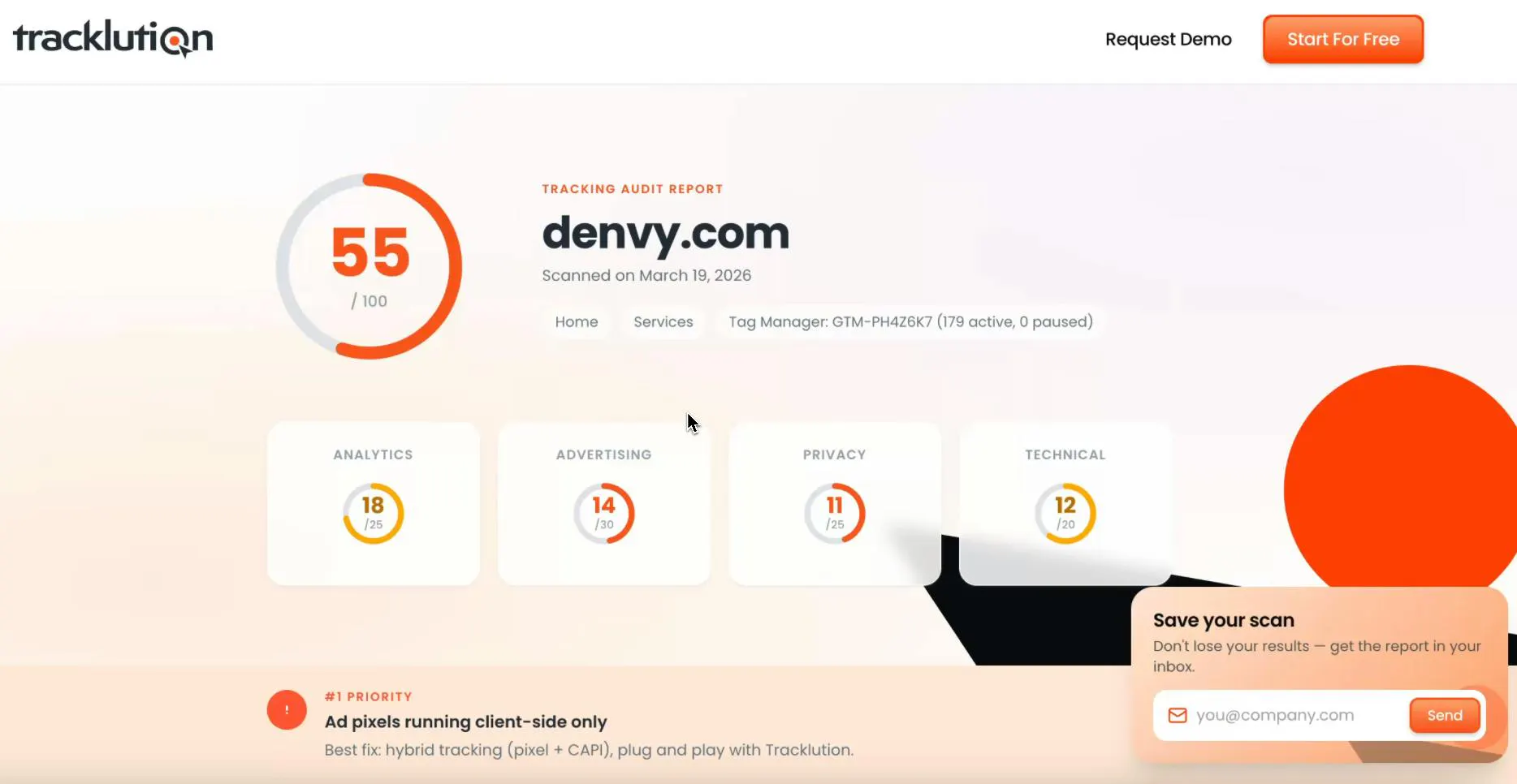
Why Client-Side Tracking Misses Conversions
Even a perfectly configured client-side tracking setup loses conversions due to browser limitations that compromise structural reliability. These include:
- Ad blockers: Roughly a third of internet users run ad blockers, which prevent scripts from firing.
- Safari’s Intelligent Tracking Prevention: Apple’s Safari is the second-most used browser and has a built-in privacy feature that limits cookie lifespan and prevents cross-site tracking.
- Consent banners: If a user declines a consent banner and then takes action on your store, the event is blocked.
- Page unloads: If a shopper quickly closes a tab after making a purchase, the tag might not finish firing, and the event will be lost. Server-side tracking doesn’t eliminate this problem, but it narrows the window using one light request instead of multiple third-party tags.
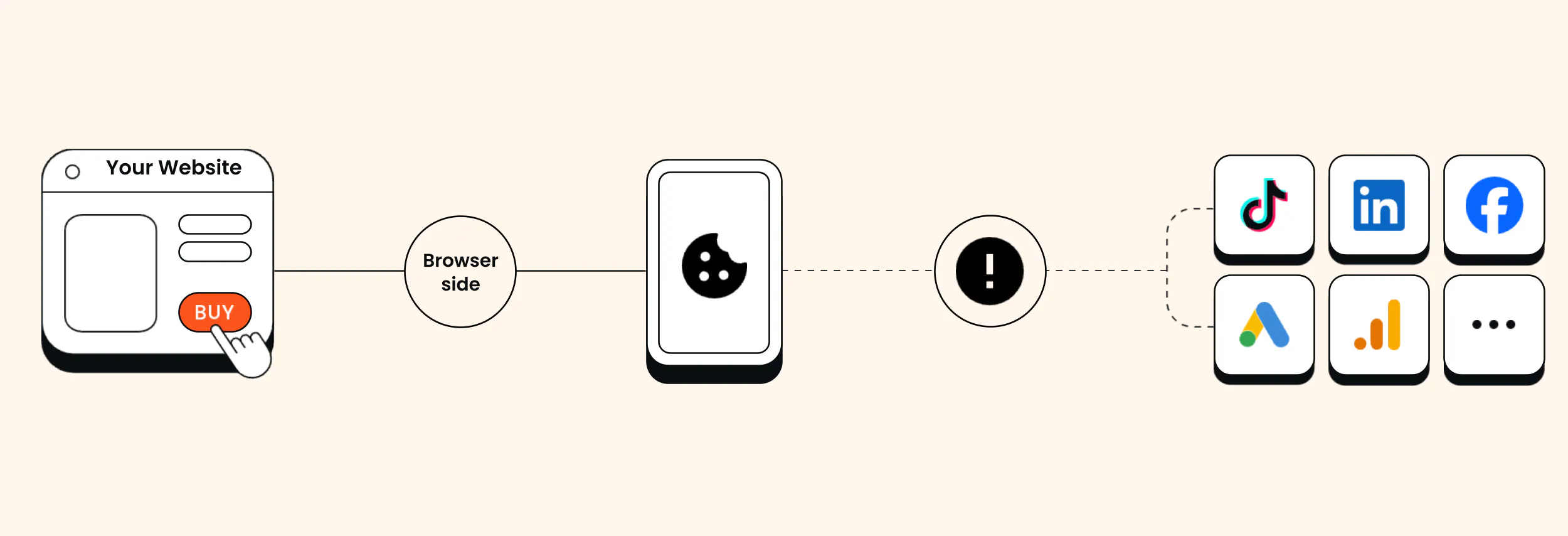
These browser obstacles are the reason you might be seeing fewer conversions on your Google Ads platform compared to your Shopify admin. The same pattern shows up across ecommerce conversion tracking setups on every platform.
While none of these pose a massive problem standalone, the compound data loss eventually leads to a significant tracking problem, which the meal kit company, Yummy, experienced firsthand.
Case Study
How Yummy recovered 30% more purchases and cut CAC by 15%
+30%
More purchases tracked vs pixel-only
-15%
Customer acquisition cost
+42%
New customers year over year
Yummy runs six-figure monthly ad budgets across Northern Europe, and their Google Tag Manager pixel setup wasn't keeping up. Moving to server-side tracking with conversion blocking and offline conversion tracking for repeat subscription purchases recovered over 30% more purchases than pixel-only tracking, cut customer acquisition cost by 15%, and supported 42% year-over-year growth in new customers.
"Getting this kind of growth in these market conditions doesn't come easy," Heiman notes. "Now that the algorithms have the right data in the right format, they just work better - the numbers speak for themselves."

Heiman Safeen
Group Growth Officer
People think they have one specific issue causing data loss. What we usually see is a bunch of small things. Consent declines, plus ad blockers, plus a couple of misconfigured tags, plus tags that don't always load because the page is slow. You lose a small percentage here and there, and all of a sudden you're losing half your data - Anni Salo, CEO at Tracklution
If you’re seeing a reporting discrepancy on your Shopify admin versus your Google Ads dashboard, this is why. It’s not a setup problem; it’s a tracking problem.
Going Further: Server-Side Tracking
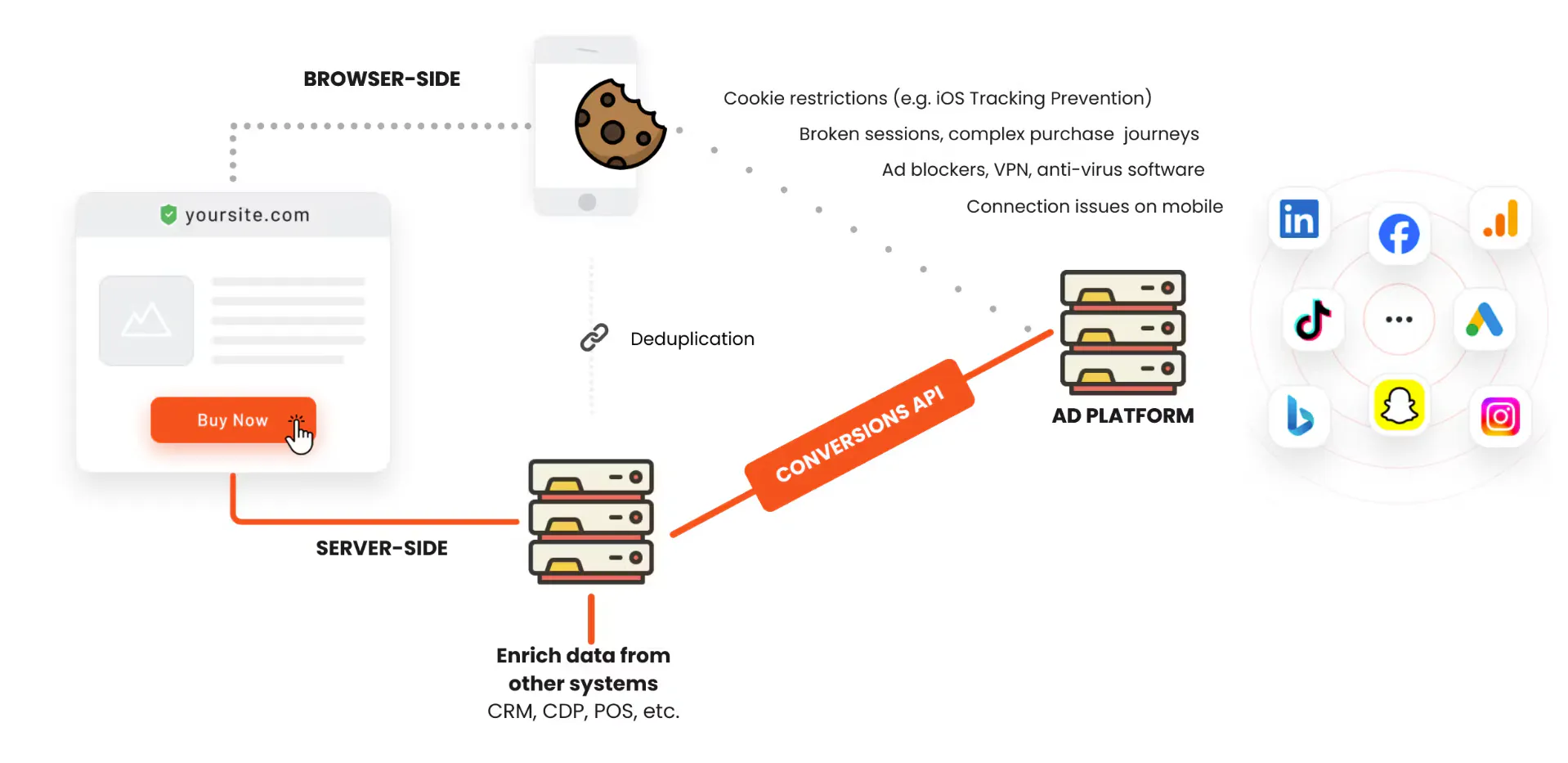
Server-side tracking takes reporting out of the browser, effectively sidestepping the above limitations. When a shopper takes an action on your site, instead of the event pinging directly from the user’s browser to Google Ads, it runs first through a server you control.
This server-to-server pathway is the core difference between client-side and server-side tracking. Events that travel server-to-server are less likely to be blocked by ad blockers; a closed tab is less likely to interrupt it, and ITP can’t kill it. Server-side tracking records conversions that would otherwise be lost, giving you and your ad algorithms a far more complete picture of your data.
Check out our guide on Google Ads server-side tracking for more depth.

In modern advertising, you win by giving algorithms the complete picture, not just part of it.
Shaan Raja,
Team Lead SEO & Integration Analyst at The Platform Group
Using Tracklution for Shopify Google Ads Tracking
Configuring your own server-side setup can be technically laborious, with costs that add up quickly. You’ll need technical expertise for setup and maintenance, plus hosting fees.
Tracklution provides managed server-to-server tracking without all the hassle. When a customer takes an action on your Shopify store, Tracklution records the events and sends them to Google via the Google Ads API.
Tracklution installs on Shopify as a native custom pixel in Customer Events, the same mechanism Shopify expects everyone to use. An order creation webhook provides a reliable second signal at the server level for every transaction, so purchases are captured even when browser-side scripts fail.
It installs in three simple steps, taking an average of 16 minutes until it's up and running.
- Add a DNS record to enable first-party data collection
- Paste the pixel in Customer Events, and then
- Connect your Google Ads account in the Tracklution dashboard
No developer resources required.
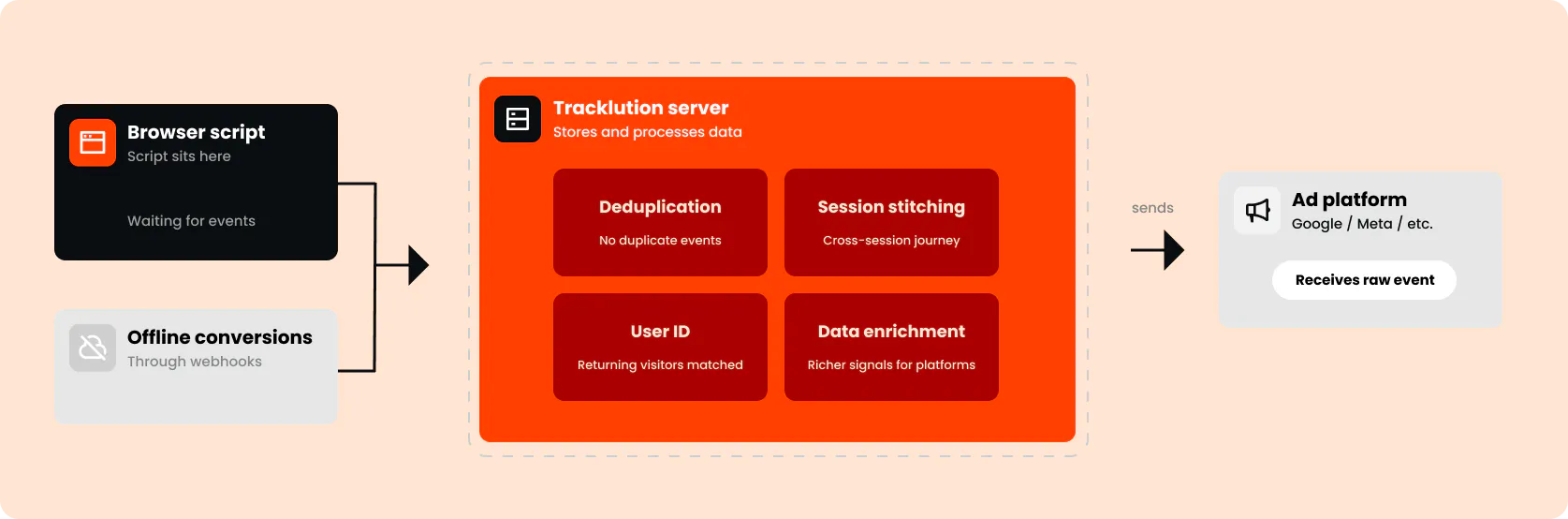
From there, Tracklution handles all of the work: configuring standard ecommerce events automatically, handling deduplication to prevent double-counting events, and keeping the API version up-to-date so that your tracking is always current. Need to track an event specific to your business? You can quickly set it up and start recording.
You can route your events to multiple ad platforms, such as Meta, LinkedIn, or GA4, from the same setup. It isn’t Shopify-specific either. You can manage server-side tracking on all major ecommerce platforms and custom setups.
Case Study
How Tonefest Guitar Gallery doubled ROAS and grew sales 36% with server-side tracking
2x
ROAS in 2 months
45%
Conversions recovered and fed back to ad platforms
36%
Increase in online store sales
Tonefest Guitar Gallery is a €1.2 million Finnish retailer competing against companies with ad budgets in the tens of millions. Incomplete conversion tracking was limiting how confidently founder Petri Matero could scale spend. After implementing server-side tracking in June 2025, Tonefest recovered 45% more conversions and doubled ROAS within two months. Integrating Shopify POS also made in-store purchases from online browsers visible in Google Ads reporting.
If you are running a shop and serve every other customer with your eyes closed, that's how marketing felt before. Tracklution lets me serve every customer with my eyes open.

Petri Matero
When you implement Shopify server-side tracking with Tracklution, attributed conversions start rising immediately as you recover lost conversions that you already earned. When do you start to see the money? Cost per conversion takes a little longer to set in but is hard to miss once it does.
According to Anni Salo, CEO at Tracklution, "depending on volume, the learning curve might take a week, a few weeks, or a few months. After that, when you compare what you've spent against the conversions you've gotten, the cost per conversion should be lower than before."
Optimize your Shopify conversion tracking
Install Tracklution as a Shopify custom pixel and start reporting conversions server-side in 16 minutes. No developer needed.
Conclusion
The gap between your store sales and Google Ads reporting is more than a tracking quirk. It directly impacts your budget spend; optimizing poorly, setting targets against underreported data, and sending resources to the wrong campaigns.
Client-side tracking is a solid starting point but eventually falls prey to browser limitations beyond your control. The Shopify stores getting ahead are the ones whose ad platforms see every conversion event. A server-side setup is the only way to make sure that happens.
Related posts

Conversion Tracking
Conversion tracking software: A practical buyer’s guide
Conversion tracking software covers many different tools solving different problems under one label. Find the category you need, with options for each.
Conversion Tracking
Conversion tracking software: A practical buyer’s guide
Conversion tracking software covers many different tools solving different problems under one label. Find the category you need, with options for each.
Conversion Tracking
Ecommerce conversion tracking: Fix your tracking gaps
See how ecommerce conversion tracking recovers lost conversions and improves marketing spend efficiency.
Conversion Tracking
Ecommerce conversion tracking: Fix your tracking gaps
See how ecommerce conversion tracking recovers lost conversions and improves marketing spend efficiency.
Conversion Tracking
Offline Conversion Tracking: What It Is, How It Works, and How to Set It Up
If your customers convert off your website - by phone, in-store, via Calendly, Stripe, or your CRM - your ad platforms may be flying blind. Here's how to fix it with offline conversion tracking.
Conversion Tracking
Offline Conversion Tracking: What It Is, How It Works, and How to Set It Up
If your customers convert off your website - by phone, in-store, via Calendly, Stripe, or your CRM - your ad platforms may be flying blind. Here's how to fix it with offline conversion tracking.
Questions and answers
What does Tracklution actually do?
Tracklution sends conversion data directly to ad platforms (Meta, Google Ads, TikTok, etc.) through server-side APIs. Instead of relying on browser pixels that get blocked by ad blockers, iOS privacy changes, and cookie restrictions, your data goes server-to-server. The result: ad platforms see more of your real conversions, their algorithms optimize better, and you get better ROAS.
What is server-side tracking?
Server-side tracking gathers first-party data directly on your website and sends tracking events to ad platforms via Conversion APIs. This approach bypasses restrictions from iOS devices, ad blockers, and privacy-focused browsers, providing more accurate data and making your paid advertising more efficient.
Is it just one setup that feeds data into all my ad platforms?
Yes. You install Tracklution once, connect your ad accounts, and it sends conversion data to all platforms simultaneously through their respective APIs (Meta CAPI, Google Ads API, TikTok Events API, etc.). No need to manage separate server-side setups for each platform.
How much more conversion data will my ad platforms actually see?
On average, clients report 34.2% more conversions compared to traditional browser-based pixels. This means the ad algorithms have significantly more signal to work with, which translates to 15-35% lower customer acquisition costs for most clients.
Do I need developers to set this up?
No. Setup takes 5-15 minutes depending on your platform. For Shopify, WooCommerce, and other supported platforms, it is plug-and-play. You do not need custom coding or engineering resources. For GTM users, you can keep your existing setup and add Tracklution alongside it.
Do I need to remove my existing tracking tags?
Not necessarily. Tracklution works alongside your current setup. You can run both in parallel initially to compare data, then decide whether to simplify.
What about the DNS / CNAME setup?
Tracklution uses a first-party CNAME record on your domain for data collection. This takes a couple of minutes to configure and up to 48 hours to propagate. It is what makes the tracking resistant to ad blockers and browser restrictions.
Can I verify that the data is actually more accurate?
Yes. Run Tracklution alongside your existing tracking and compare. The dashboard also shows "recovered events" so you can see exactly how many conversions would have been missed without server-side tracking.
Can I distinguish between organic and paid traffic?
Yes. Tracklution preserves traffic source attribution. The conversion data sent to each ad platform includes the proper attribution parameters.
What about offline conversions (phone calls, in-store, CRM events)?
Tracklution supports offline conversion tracking through webhooks and CRM integrations. If someone clicks an ad, then converts offline, you can feed that back to the ad platforms. Clients using this see up to 35% reduction in acquisition costs because the algorithms learn from the full conversion picture.
How does this work with cookie consent and CMP tools?
Tracklution supports both Basic and Advanced Consent Mode. It reads your CMP data layer automatically and respects user consent choices. In Advanced Consent Mode, it can still collect anonymized, cookieless data when users decline cookies, which helps ad platform modeling without violating privacy rules. Fully GDPR-compliant.
How is this different from Stape or building your own sGTM setup?
Stape provides server-side GTM hosting, which means you still need to build and maintain the tags, triggers, and configuration yourself. Tracklution is a complete solution: plug-and-play setup, automatic event detection, built-in consent management, a real-time analytics dashboard, and ongoing maintenance of all API connections. When ad platforms change their APIs (which happens often), we handle the updates.
How does the agency partner model work?
Single dashboard to manage all client accounts. Each client has their own tracking container. The platform handles all technical maintenance, so you are not stuck troubleshooting API changes or broken tracking.

Have further questions?