
If Tracklution is server-side, why use a browser script?
Tracklution server-side tracking still uses a browser script, but not to process data. We tell you why it matters, and what happens on the server.

Table of contents
Better data.
Set up server-side tracking in minutes with Tracklution. Send better conversion data to your ad platforms so their algorithms can optimise for better results from your budget.
Start your free trialIf you began the Tracklution installation process, you might have noticed that you do have to install a browser script to get it running.
So, why would server-side tracking software use a browser script to begin with?
The TL;DR version
It’s actually quite simple:
- The browser script collects data (unlike regular tracking scripts, it can load under your own domain, as part of your website, not as a third-party tag).
- The Tracklution server processes it.
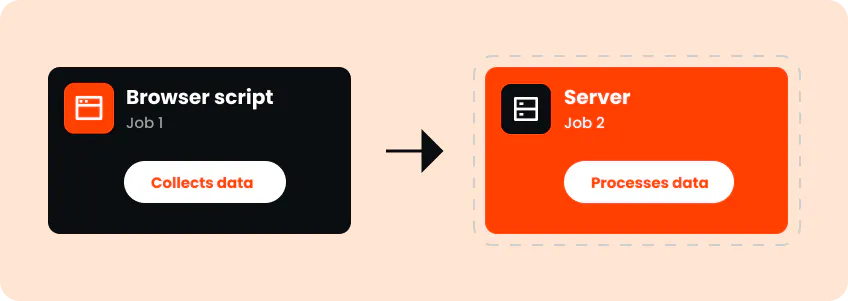
As visualised above, those are two different jobs, and confusing them is what makes this feel like a contradiction (when it isn't).
The security camera analogy
The way I like to explain this is from the perspective of a security camera.
The camera captures what's happening and sends the footage to a recording server. The camera itself doesn't store or analyze faces, flag suspicious behavior, or make any decisions.
It records, transmits, and the intelligence lives on the server.
Tracklution's browser script works the same way.
It captures what's happening in the user's browser and sends it to the server. The script doesn't process, enrich, or decide anything. That all happens server-side.
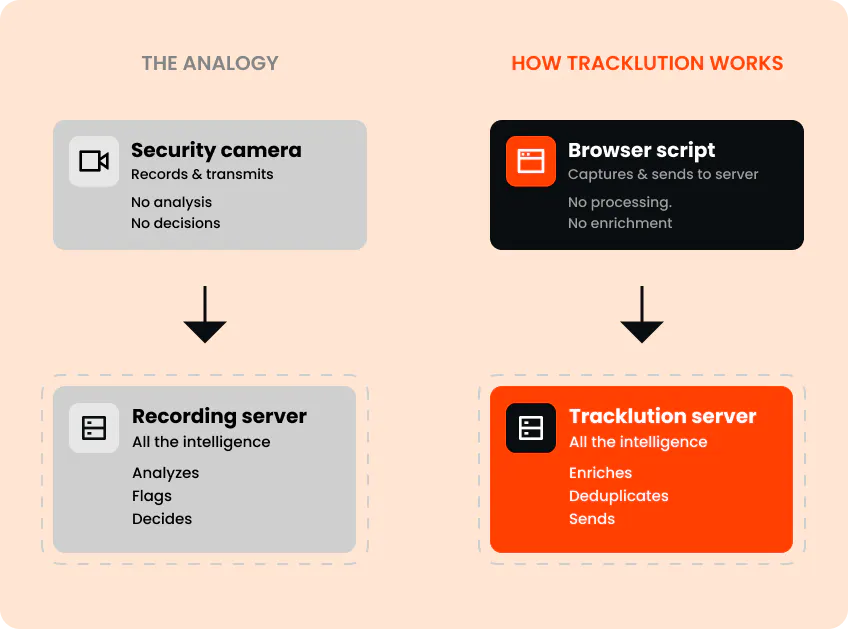
Without the camera, nothing gets captured.
And without the browser script, nothing gets captured.
Client-side tracking vs. what Tracklution enables
Here’s what client-side tracking looks like in practice.
- A script sits in the browser,
- captures an event (a purchase, for instance),
- does light processing activities, like hashing, if and when needed,
- sends it directly to the ad platform.
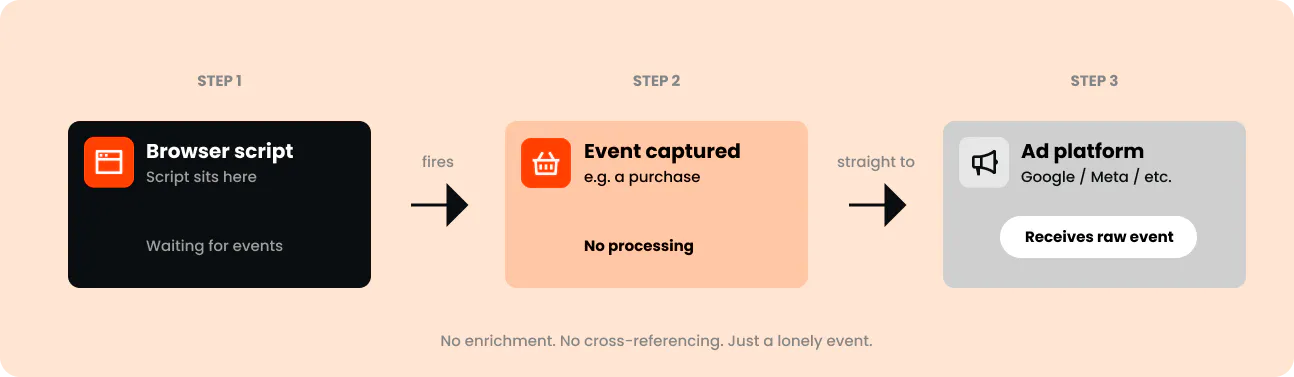
That's it.
A pipe.
The event travels in a pipe, from the browser to Google or Meta (or any other ad platform) with no stop in between, no enrichment, no cross-referencing with anything else.
And if something gets in the way (ad blocker, or cookie restrictions), ad platforms won’t receive that information.
"If you use client-side tracking, you try to send the same event directly to the ad platform from the browser without any processing. And that loses so much, because you can't combine it with anything else. It's just a lonely little event." — Sami Soiluva, CTO, Tracklution
The added value from server-side tracking with Tracklution
With Tracklution, the script sits in the browser and captures the same events.
But instead of going directly to an ad platform, the event goes to the server.
Meet hybrid server-side tracking
More than server-side tracking, Tracklution actually makes hybrid server-side tracking possible.
Uh? On top of capturing and processing events fired from the browser, you can also feed your server with offline conversions (CRM updates, brick and mortar conversions, phone orders, subscription renewals, etc.), through webhooks, to train ad platform algorithms with the most complete and accurate data.
And if you want to learn more about how Tracklution manages offline conversions, check this walkthrough from Emma, Customer Success Manager at Tracklution.
From there, it's stored and processed against historical data before being sent on to the ad platform.
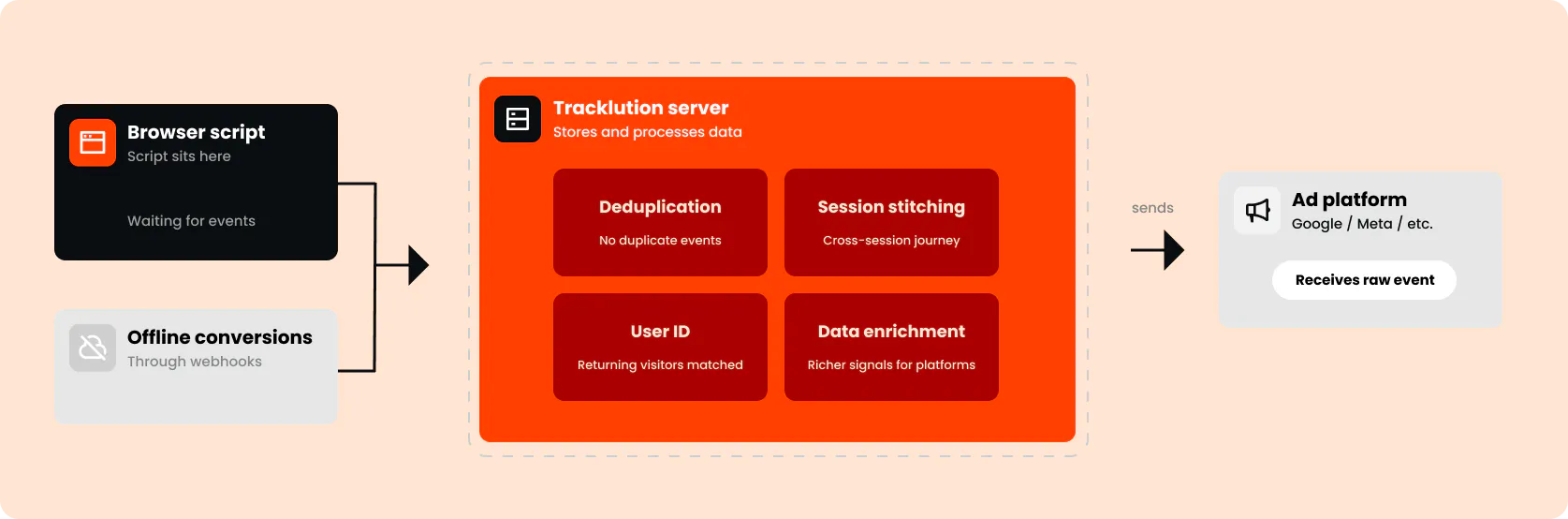
That processing step is where the added value of Tracklution is: deduplication of events, session stitching, user identification, data enrichment… None of that is possible when you're sending events directly from the browser in real time.
"All the processing happens on the server instead of putting that load on the browser. That's why you still use light scripts to collect information, but want to move the processing to the server." — Lucas Nilsson, Product Specialist @ Tracklution
In short, scripts are the best tool for capturing events in the browser, especially in a first-party context. Everything after that—transforming, enriching, cleaning the data, and making sure it actually reaches ad platforms—is dealt with server-side, as visualized below.
Related posts
Ask Tracklution
Is server-side tracking just better reporting?
Server-side tracking recovers conversions your pixel misses. Is that just better reporting, or does it actually change how your ads perform?
Ask Tracklution
Is server-side tracking just better reporting?
Server-side tracking recovers conversions your pixel misses. Is that just better reporting, or does it actually change how your ads perform?
Ask Tracklution
Do you need your own server to do server-side tracking?
No, you don't need your own server for server-side tracking. Here's what it actually takes and your three real options.
Ask Tracklution
Do you need your own server to do server-side tracking?
No, you don't need your own server for server-side tracking. Here's what it actually takes and your three real options.
Ask Tracklution
Server-side tracking, server-side tagging, gateways: what's the difference?
Client-side, server-side, and gateways explained: what each one actually does, how they differ, and which is right for you.
Ask Tracklution
Server-side tracking, server-side tagging, gateways: what's the difference?
Client-side, server-side, and gateways explained: what each one actually does, how they differ, and which is right for you.
Questions and answers
What does Tracklution actually do?
Tracklution sends conversion data directly to ad platforms (Meta, Google Ads, TikTok, etc.) through server-side APIs. Instead of relying on browser pixels that get blocked by ad blockers, iOS privacy changes, and cookie restrictions, your data goes server-to-server. The result: ad platforms see more of your real conversions, their algorithms optimize better, and you get better ROAS.
What is server-side tracking?
Server-side tracking gathers first-party data directly on your website and sends tracking events to ad platforms via Conversion APIs. This approach bypasses restrictions from iOS devices, ad blockers, and privacy-focused browsers, providing more accurate data and making your paid advertising more efficient.
Is it just one setup that feeds data into all my ad platforms?
Yes. You install Tracklution once, connect your ad accounts, and it sends conversion data to all platforms simultaneously through their respective APIs (Meta CAPI, Google Ads API, TikTok Events API, etc.). No need to manage separate server-side setups for each platform.
How much more conversion data will my ad platforms actually see?
On average, clients report 34.2% more conversions compared to traditional browser-based pixels. This means the ad algorithms have significantly more signal to work with, which translates to 15-35% lower customer acquisition costs for most clients.
Do I need developers to set this up?
No. Setup takes 5-15 minutes depending on your platform. For Shopify, WooCommerce, and other supported platforms, it is plug-and-play. You do not need custom coding or engineering resources. For GTM users, you can keep your existing setup and add Tracklution alongside it.
Do I need to remove my existing tracking tags?
Not necessarily. Tracklution works alongside your current setup. You can run both in parallel initially to compare data, then decide whether to simplify.
What about the DNS / CNAME setup?
Tracklution uses a first-party CNAME record on your domain for data collection. This takes a couple of minutes to configure and up to 48 hours to propagate. It is what makes the tracking resistant to ad blockers and browser restrictions.
Can I verify that the data is actually more accurate?
Yes. Run Tracklution alongside your existing tracking and compare. The dashboard also shows "recovered events" so you can see exactly how many conversions would have been missed without server-side tracking.
Can I distinguish between organic and paid traffic?
Yes. Tracklution preserves traffic source attribution. The conversion data sent to each ad platform includes the proper attribution parameters.
What about offline conversions (phone calls, in-store, CRM events)?
Tracklution supports offline conversion tracking through webhooks and CRM integrations. If someone clicks an ad, then converts offline, you can feed that back to the ad platforms. Clients using this see up to 35% reduction in acquisition costs because the algorithms learn from the full conversion picture.
How does this work with cookie consent and CMP tools?
Tracklution supports both Basic and Advanced Consent Mode. It reads your CMP data layer automatically and respects user consent choices. In Advanced Consent Mode, it can still collect anonymized, cookieless data when users decline cookies, which helps ad platform modeling without violating privacy rules. Fully GDPR-compliant.
How is this different from Stape or building your own sGTM setup?
Stape provides server-side GTM hosting, which means you still need to build and maintain the tags, triggers, and configuration yourself. Tracklution is a complete solution: plug-and-play setup, automatic event detection, built-in consent management, a real-time analytics dashboard, and ongoing maintenance of all API connections. When ad platforms change their APIs (which happens often), we handle the updates.
How does the agency partner model work?
Single dashboard to manage all client accounts. Each client has their own tracking container. The platform handles all technical maintenance, so you are not stuck troubleshooting API changes or broken tracking.

Have further questions?