
Product Update 03/24: Spotlight on Tracklution's Webhook
During the past month, our team has been hard at work expanding the webhook's functionality, ensuring it caters to a broader array of use cases. Thus, it became quite clear: This product update must center around the webhook and its various use cases!

Table of contents
Better data.
Set up server-side tracking in minutes with Tracklution. Send better conversion data to your ad platforms so their algorithms can optimise for better results from your budget.
Start your free trialWelcome to our latest product update! This month, we're thrilled to shine a spotlight on Tracklution's webhook and its growing capabilities, which have captured our community's attention due to their potential to significantly enhance web session data. During the past month, our team has been hard at work expanding the webhook's functionality, ensuring it caters to a broader array of use cases. Thus, it became quite clear: This product update must center around the webhook and its various use cases!
Table of Contents
- Webhook, what the heck?
- Use cases for webhook
- Technical information of the implementation
- Other recent updates
Webhook, what the heck?
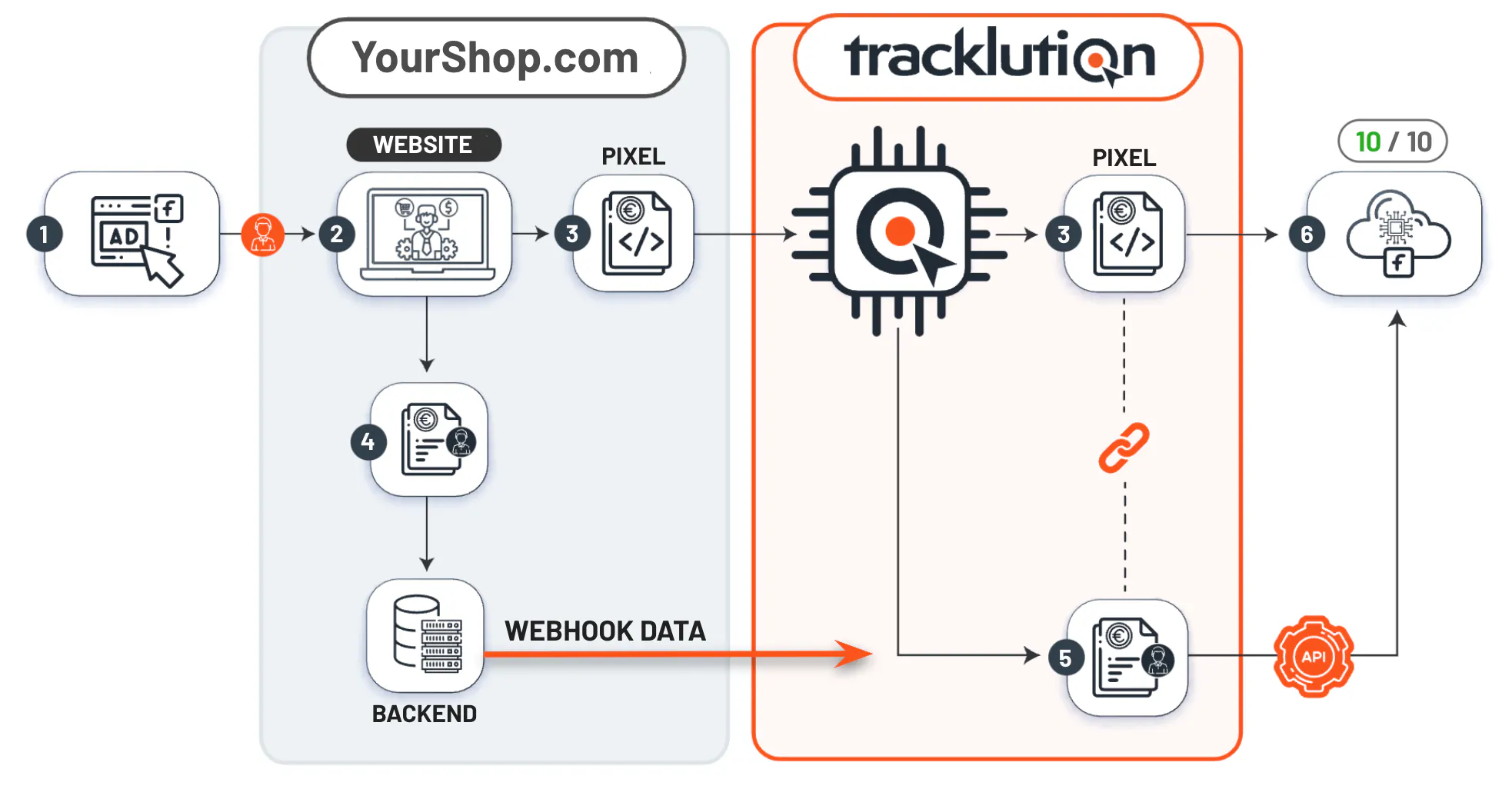
Tracklution's webhook provides a seamless and efficient way to complement web session data with additional information and events from various external systems, including but not limited to CRM, booking systems, billing systems, ERP, and calling systems.
Webhook enables advertisers to effortlessly bring additional tracking data to Tracklution, such as offline conversions and enrichment of existing web conversions. Whether it's obtaining insights from sources that may not be directly linked to the website or safeguarding sensitive information, Tracklution's webhook offers a user-friendly and powerful solution for optimising data flow.
Use cases for webhook
The webhook can be used in many ways, and we've shared some common examples. If you're using it differently or have new ideas, we'd love to hear about them!
Recording Missing Events:
With webhook, users can capture events that were not recorded through web tracking, ensuring no data is lost, while also ensuring no data is recorded twice by deduplicating those events that already were collected from the web.
Record Offline Events:
Webhook offers a seamless integration for bringing in signals from offline interactions, such as in-person visits, calls, and customer service engagements, offering a more comprehensive view of customer activities. These activities can naturally be combined with web sessions, if such matchable web session data is available.
Profit Tracking:
By importing profit data directly from backend systems with webhook, companies can safeguard their sensitive profit margin information, as this data is transferred securely with server-to-server connection, instead of exposing it to your website users via client-side tracking. It also provides more accurate profit tracking, when accurate profit data can be brought in from the backend system, instead of estimations that are often used when tracking profit in client-side (e.g. high-mid-low profit margin product classifications).
Enriching Existing Data:
In some cases there might be technical limitations to what can be collected from the website during the session with tracking pixels. In these cases, webhook might save the day (and plenty of work hours), when the additional data that cannot be recorded client-side can be enriched to the session with webhook.
Safeguarding Sensitive Information:
The webhook ensures sensitive data is processed securely with server-to-server connection, without being exposed on the client-side, where any tech-savvy user could access it.
Technical information of the implementation
Implementing Tracklution's webhook is straightforward. A webhook endpoint is automatically created for each tracking container, supporting both GET and POST requests.
Webhook’s capabilities are improving continuously, and on top of the standard Tracklution format, it’s smart enough to automatically read webhook payloads from Shopify, Woocommerce, Typeform, and Tally in their native formats. Support to different platforms will be added as needs emerge from our clients, so don't hesitate to reach out.
Webhook features session-level data matching for adding information at the session level, and event-level data matching for making conversion adjustments for single events and recording potentially missing conversions. For deduplication, webhook utilises event IDs to eliminate duplicates recorded from both, the pixel and the webhook.
More detailed information regarding the installation as well as the unique endpoint for your Tracking Container is provided in Tracklution’s onboarding flow and in our general documentation.
Other recent updates
In addition to the webhook enhancements, we've made several minor updates, such as:
- Patches to our newest connector, GA4, for even better and more accurate analytics
- LinkedIn Conversions API proceeded to internal test use – soon it will be rolled out to all Tracklution users!
- Patches to searches in Tracklution Dashboard: More flexible search and better filtering capabilities
- Improvements to eCommerce tracking to GA4, Tiktok and Meta connectors
- Improved documentation based on our clients’ most asked questions
- Clearer onboarding experience with more detailed installation instructions and easy ways to share instructions with colleagues
That's it for today!
By leveraging Tracklution's webhook, companies can now enjoy a more nuanced and comprehensive approach to tracking and analysis, ensuring that every customer interaction contributes to the larger picture of their marketing (and sales) strategies.
Related posts

Product updates
PII redaction, more connectors, improved UI: September 2026 update
PII redaction, 7 new ad connectors, and Microsoft Ads Conversions API for everyone.
Product updates
PII redaction, more connectors, improved UI: September 2026 update
PII redaction, 7 new ad connectors, and Microsoft Ads Conversions API for everyone.
Product updates
Your tracking data, more accurate than ever: August product update
Sharper consent visibility, more accurate GA4 data, a smarter WooCommerce plugin, and lockable webhooks. Everything new this August.
Product updates
Your tracking data, more accurate than ever: August product update
Sharper consent visibility, more accurate GA4 data, a smarter WooCommerce plugin, and lockable webhooks. Everything new this August.
Product updates
Tracklution product update: July 2026
Discover Tracklution's July updates: improved GA4 tracking, Meta attribution insights, stronger first-party tracking, and enhanced reporting.
Product updates
Tracklution product update: July 2026
Discover Tracklution's July updates: improved GA4 tracking, Meta attribution insights, stronger first-party tracking, and enhanced reporting.
Questions and answers
What does Tracklution actually do?
Tracklution sends conversion data directly to ad platforms (Meta, Google Ads, TikTok, etc.) through server-side APIs. Instead of relying on browser pixels that get blocked by ad blockers, iOS privacy changes, and cookie restrictions, your data goes server-to-server. The result: ad platforms see more of your real conversions, their algorithms optimize better, and you get better ROAS.
What is server-side tracking?
Server-side tracking gathers first-party data directly on your website and sends tracking events to ad platforms via Conversion APIs. This approach bypasses restrictions from iOS devices, ad blockers, and privacy-focused browsers, providing more accurate data and making your paid advertising more efficient.
Is it just one setup that feeds data into all my ad platforms?
Yes. You install Tracklution once, connect your ad accounts, and it sends conversion data to all platforms simultaneously through their respective APIs (Meta CAPI, Google Ads API, TikTok Events API, etc.). No need to manage separate server-side setups for each platform.
How much more conversion data will my ad platforms actually see?
On average, clients report 34.2% more conversions compared to traditional browser-based pixels. This means the ad algorithms have significantly more signal to work with, which translates to 15-35% lower customer acquisition costs for most clients.
Do I need developers to set this up?
No. Setup takes 5-15 minutes depending on your platform. For Shopify, WooCommerce, and other supported platforms, it is plug-and-play. You do not need custom coding or engineering resources. For GTM users, you can keep your existing setup and add Tracklution alongside it.
Do I need to remove my existing tracking tags?
Not necessarily. Tracklution works alongside your current setup. You can run both in parallel initially to compare data, then decide whether to simplify.
What about the DNS / CNAME setup?
Tracklution uses a first-party CNAME record on your domain for data collection. This takes a couple of minutes to configure and up to 48 hours to propagate. It is what makes the tracking resistant to ad blockers and browser restrictions.
Can I verify that the data is actually more accurate?
Yes. Run Tracklution alongside your existing tracking and compare. The dashboard also shows "recovered events" so you can see exactly how many conversions would have been missed without server-side tracking.
Can I distinguish between organic and paid traffic?
Yes. Tracklution preserves traffic source attribution. The conversion data sent to each ad platform includes the proper attribution parameters.
What about offline conversions (phone calls, in-store, CRM events)?
Tracklution supports offline conversion tracking through webhooks and CRM integrations. If someone clicks an ad, then converts offline, you can feed that back to the ad platforms. Clients using this see up to 35% reduction in acquisition costs because the algorithms learn from the full conversion picture.
How does this work with cookie consent and CMP tools?
Tracklution supports both Basic and Advanced Consent Mode. It reads your CMP data layer automatically and respects user consent choices. In Advanced Consent Mode, it can still collect anonymized, cookieless data when users decline cookies, which helps ad platform modeling without violating privacy rules. Fully GDPR-compliant.
How is this different from Stape or building your own sGTM setup?
Stape provides server-side GTM hosting, which means you still need to build and maintain the tags, triggers, and configuration yourself. Tracklution is a complete solution: plug-and-play setup, automatic event detection, built-in consent management, a real-time analytics dashboard, and ongoing maintenance of all API connections. When ad platforms change their APIs (which happens often), we handle the updates.
How does the agency partner model work?
Single dashboard to manage all client accounts. Each client has their own tracking container. The platform handles all technical maintenance, so you are not stuck troubleshooting API changes or broken tracking.

Have further questions?
Already convinced? Get 100% accurate data with server side tracking
Already convinced? Get 100% accurate data with server side tracking